
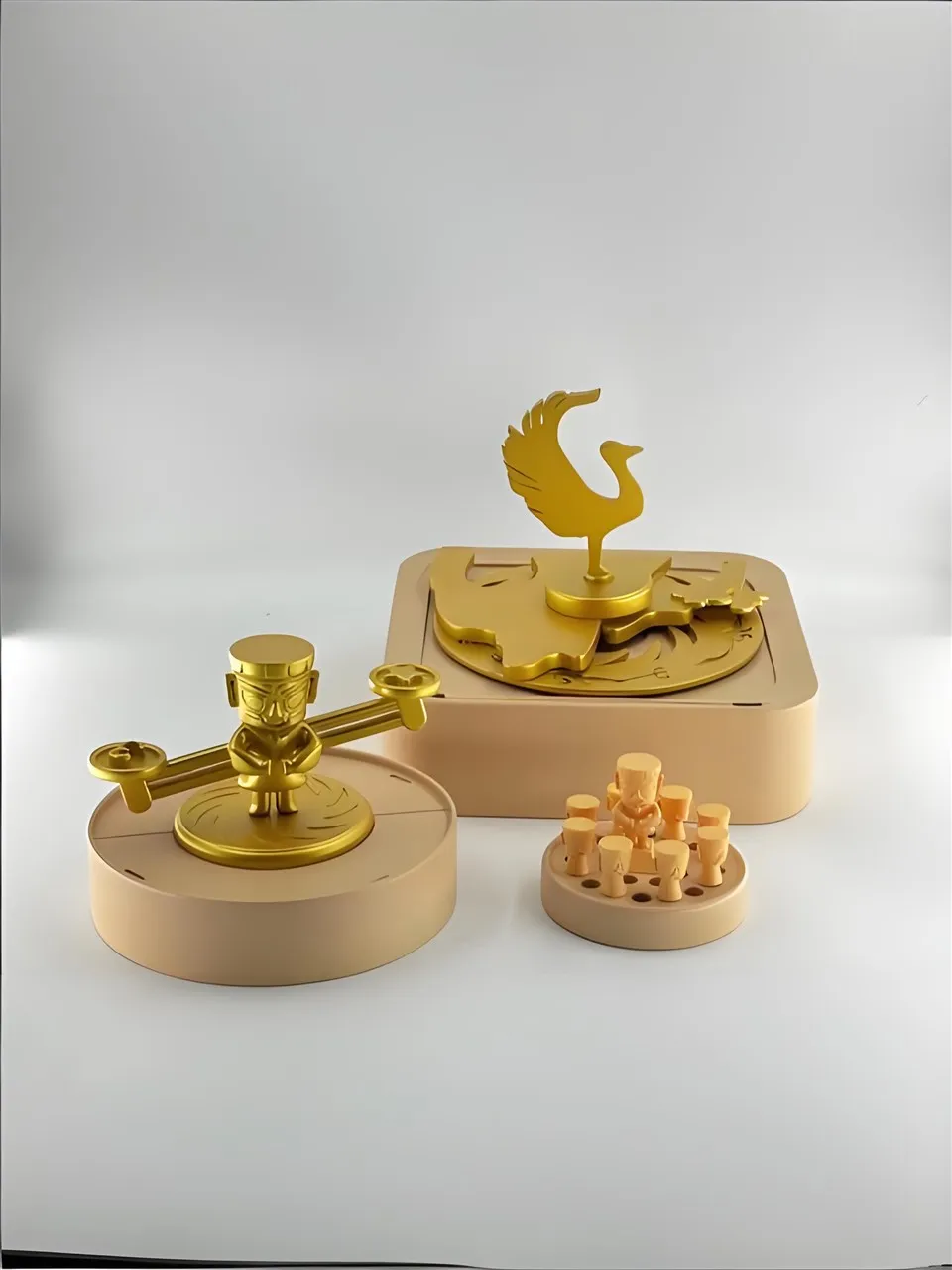
3D Printing Copper
Shenzhen JR Technology Co., Ltd. is one of the leading manufacturers and suppliers of 3d printing copper in China, featured by quality products and good price. If you're going to buy advanced 3d printing copper made in China, welcome to get quotation from our factory. Customized orders are welcome.
Product advantages

Excellent Electrical Conductivity
3D printed copper parts offer outstanding electrical conductivity, making them ideal for electrical, electronic, and high-frequency applications. By using high-purity copper powder and optimized printing parameters, the conductivity of printed components can approach that of traditionally manufactured copper parts.
This makes copper additive manufacturing highly suitable for:
Busbars
RF components
Connectors
Induction coils
Electrical contacts
Compared with conventional manufacturing methods, copper 3D printing enables more complex conductive structures while maintaining excellent electrical performance.
Outstanding Thermal Conductivity
Copper is one of the best thermal conductive metals available, and 3D printing technology allows engineers to fully utilize this advantage.
Complex internal cooling channels, lattice structures, and lightweight heat dissipation designs can be directly manufactured in a single process, significantly improving heat transfer efficiency.
This advantage is especially valuable for:
Heat exchangers
Heat sinks
Cooling plates
EV battery cooling systems
Industrial thermal management components
By optimizing internal geometries, copper 3D printed parts can improve cooling efficiency while reducing overall system size and weight.


Ability to Manufacture Complex Geometries
Traditional CNC machining and casting often struggle with highly complex copper structures. Copper 3D printing removes many of these limitations.
Complex features such as:
Internal flow channels
Hollow structures
Lightweight lattices
Conformal cooling channels
Integrated assemblies
can all be produced directly without additional tooling or complicated assembly processes.
This design freedom allows engineers to create high-performance copper components that were previously impossible or too expensive to manufacture.
Reduced Material Waste
Copper material is expensive, and traditional machining methods usually generate a large amount of waste material during processing.
3D printing uses an additive manufacturing process, building parts layer by layer only where material is needed. This greatly reduces raw material waste and improves material utilization.
For customized or low-volume copper parts, additive manufacturing can significantly lower overall production costs.


Faster Prototyping and Shorter Lead Times
Copper 3D printing eliminates the need for molds, tooling, and many secondary machining processes.
This allows manufacturers to:
Accelerate product development
Reduce prototyping cycles
Quickly validate designs
Speed up market launch
For industries requiring rapid innovation and customized solutions, copper additive manufacturing provides a major time advantage compared with conventional production methods.
Copper Materials Available for 3D Printing
Our engineers recommend materials based on your specific conductivity, strength, and application needs.
|
Material |
Purity/Composition |
Conductivity |
Key Applications |
Compatible Processes |
|
Pure Copper (Cu) |
≥99.9% |
>95% IACS |
Electrical conductors, heat management |
SLM / LPBF |
|
Copper Chrome (CuCr1Zr) |
Cu + Cr + Zr |
~80% IACS |
Welding electrodes, high-temp molds |
SLM |
|
Bronze (CuSn10) |
Cu + 10% Sn |
Good |
Bearings, decorative, wear parts |
Binder Jetting |
|
Copper Nickel |
Cu + Ni |
Excellent corrosion resistance |
Marine, electronics |
SLM |
"Our engineers recommend Pure Copper for RF waveguides and high-conductivity busbars based on extensive testing."
Applications of 3D Printed Copper Parts
Electronics & Electrical
Conductors, busbars, connectors, and RF/microwave waveguides. Complex copper electrical components achieve superior performance.
Electric Vehicles (EV)
Motor windings, heat exchangers, and thermal management parts (3D printed copper EV parts).
Aerospace
Thrust chambers, rocket nozzles, and conformal cooling channels (copper additive manufacturing aerospace).
Industrial
Conformal cooling inserts for molds that reduce cycle times significantly.
Medical
Antimicrobial copper structures and heat-dissipating instruments.
Defense & RF
Waveguides, antennas, and high-frequency components.
Manufacturing Process
Copper's high reflectivity and thermal conductivity make it one of the most challenging metals for additive manufacturing. We overcome this with optimized parameters, green/blue laser systems where applicable, and proven expertise.
Step-by-Step Process:
1.DfAM Design Consultation
2.File Analysis (STL/STEP) & Optimization
3.Parameter Setting (laser power, scan strategy)
4.SLM / Binder Jetting Printing
5.Depowdering / Debinding & Sintering
6.Post-Processing (heat treatment, machining)
7.Quality Inspection (CMM, density testing, conductivity verification)
8.Delivery with full documentation
We utilize advanced equipment (e.g., high-precision SLM systems) for dense, high-conductivity parts. Keywords: copper SLM printing, copper additive manufacturing, LPBF copper.
Surface Finishing
Surface Finishing Options for Copper 3D Printed Parts
|
Process |
Effect |
Typical Applications |
Roughness (Ra) |
|
Electrochemical Polishing |
Mirror-like smooth finish |
Conductors, decorative |
<0.4 μm |
|
Sandblasting |
Uniform matte |
Industrial structural |
1–3 μm |
|
Nickel/Silver Plating |
Oxidation protection, enhanced conductivity |
Electronic connectors |
- |
|
CNC Post-Machining |
High-precision tolerances |
Mating parts |
Custom |
|
Passivation / Coatings |
Anti-tarnish |
Long-term storage |
- |
Why Choose Our Copper 3D Printing Service?
Ultra-High Conductivity
(>95% IACS for pure copper)
Ideal for electrical and thermal management applications. Our optimized processes deliver near-wrought properties.
Excellent Thermal Performance (~380–400 W/m·K)
Superior heat dissipation for heat exchangers, cooling systems, and high-power electronics.
Complex Internal Features
& Conformal Cooling
One-piece internal cavities and optimized flow channels that are impossible or costly with CNC machining.
High Material Utilization
Reduces waste of expensive copper compared to subtractive methods, supporting sustainable manufacturing.
Fast Lead Times
(3–7 business days)
From design to delivery for qualified parts.
ISO-Certified Quality
Full traceability, density testing, and inspection reports with every order.
FAQ
Q: What is the minimum wall thickness for 3D printing copper?
A: Typically 0.5–1.0 mm depending on geometry and process. We provide DfAM guidance for optimal results.
Q: How does copper 3D printing compare to CNC machining copper?
A: 3D printing excels at complex internal features and reduces material waste, while CNC offers tighter tolerances on simpler geometries.
Q: What purity level can you achieve with 3D printed copper parts?
A: We achieve ≥99.9% for pure copper with high density (>98%) and conductivity approaching wrought material.
Q: Is copper 3D printing suitable for high-frequency RF applications?
A: Yes - excellent for copper RF 3D printing waveguides and antennas due to superior conductivity.
Q: What file formats do you accept?
A: STL, STEP, IGES. We assist with optimization.
Q: How long does it take to 3D print copper parts?
A: Typically 3–7 business days, depending on size and post-processing.
Q: Can you 3D print copper with internal channels for cooling?
A: Absolutely - conformal cooling channels are a key strength of copper additive manufacturing.
Hot Tags: 3d printing copper, China, suppliers, manufacturers, factory, customized, price, quotation
Send Inquiry
