
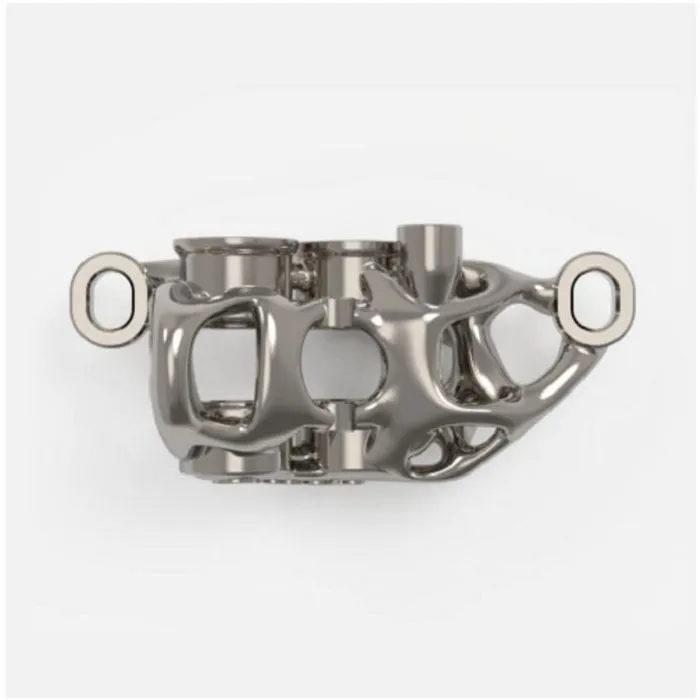
Laser Printing in Metal
Metal 3D Printing Service has many advantages over traditional CNC machining, casting, or forging. It gives designers more freedom, allows for better structural integration, and speeds up product iteration. This makes it great for small batch high-performance applications, complex parts, and lightweight structures.
Send Inquiry
Product Details ofLaser Printing in Metal
Shenzhen JR Precision Technology Co., Ltd. is one of the leading manufacturers and suppliers of laser printing in metal in China, featured by quality products and good price. If you're going to buy advanced laser printing in metal made in China, welcome to get quotation from our factory. Customized orders are welcome.
Metal materials
laser printing on metal works with a wide range of industrial-grade metals to fulfill diverse needs for strength, corrosion resistance, and use at high temperatures:
Stainless steel, such 316L and 17-4PH, is widely utilized in industry and medicine since it doesn't rust easily and has steady overall performance.
Aluminum alloy, like AlSi10Mg, is light, has strong heat conductivity, and is good for cars, electronics, and structural parts.
Titanium alloys, such Ti6Al4V, are very strong, light, and biocompatible. They are often employed in aerospace and medical applications.
Tool steel and mold steel are robust and resistant to wear, making them good for molds and functional parts.
Nickel-based high-temperature alloys, like Inconel 718/625, can handle high temperatures and creep, making them good for very tough working conditions.
You can always find out where metal powders come from, and their particle size and chemical makeup stay the same, which makes sure that the printing process and the final result work the same way.
Metal laser printing process
Metal Laser 3D Printing is mostly based on these well-established process technologies:
SLM/LPBF (laser selective melting)
This is the most common way to print metal with a laser. It employs a high-precision laser to melt metal powder in the powder bed layer by layer, making it possible to make metal items with high density and precision. This method works well for complicated interior structures and functional parts that need to work well.
DMLS stands for Direct Metal Laser Sintering
It works with several types of engineering metals, just like the SLM principle. The parts that are printed have strong mechanical qualities and stability, thus they are frequently employed in industrial manufacturing.
DED/LENS (Directed Energy Deposition)
It can directly deposit materials on existing metal substrates and is good for making large components and fixing metal. It is also good for fixing industrial equipment and molds.
When the right process settings and structural design are used, metal laser printed items can have mechanical qualities that are similar to or better than those made with traditional methods.
Technology for post-processing
Post-processing is a necessary and vital part of Laser Metal Printing Service since it directly influences how well the parts work and how they look.
Take away any support structures that are needed during printing
Heat treatment, which includes annealing and aging treatment, is used to relieve internal stress and make materials better.
HIP (hot isostatic pressing) makes the material denser on the inside, makes micropores smaller, and makes it better at handling fatigue.
CNC precision machining: used to control key dimensions and make assembly surfaces with high precision
Sandblasting, polishing, spraying, and other surface treatments can make things look and work better.
A methodical post-processing technique may make sure that metal laser printed parts fulfill the needs of real-world use and industry standards.
FAQ
Q1: Is the strength of Laser Printing in Metal reliable?
A: Yes, with reasonable process control and post-processing, the strength and density of metal laser printed parts can reach or even exceed the level of castings.
Q2: Are all metal parts suitable for laser printing?
A: Metal laser printing is particularly suitable for complex structures, small batches, and high-performance parts. For simple large batch parts, traditional processes may have a cost advantage.
Q3: Do printed documents need post-processing?
A: Most applications require post-processing to improve mechanical performance, dimensional accuracy, and surface quality.
Q4: Can Laser Printing in Metal be used for end products?
A: Yes, this technology has been widely used in terminal functional components in aerospace, medical, automotive and other fields.
Q5: How long is the usual delivery time?
A: Depending on the material, size, and post-processing requirements, it is usually faster than traditional manufacturing methods and particularly suitable for rapid iteration projects.
Hot Tags: laser printing in metal, China, suppliers, manufacturers, factory, customized, price, quotation, 3D Printing Material Titanium, 3d pringted high performance car parts, 3d printed plastic intake manifold, parts of a race car, manifold blocks, 3d rapid prints
Previous
Tpu PrintingSend Inquiry
