
3D printing technology is driving change across automotive manufacturing in multiple ways - prototype design and validation, production tooling, end-use part manufacturing, and process and material certification - and is gradually moving the industry toward a future where an entire vehicle could be 3D printed. Here's a closer look:
Prototype Design and Validation of New Components
Fit and assembly checks: Automakers use 3D printing to quickly produce full-scale prototypes - side mirrors, for example - using FFF/FDM technology to affordably verify part fit and assembly feasibility.
Functional prototype validation: For parts that need high strength or a smooth surface finish (such as mounts or aerodynamic kits), resin- and powder-based technologies like Selective Laser Sintering (SLS), combined with composites or nylon, ensure the prototype meets performance requirements.
Full-color model displays: Material jetting and 3D inkjet technologies are used to produce full-color concept models or scale mockups, supporting design reviews and market presentations.
The Deeper Value of Prototype Validation
Prototype validation isn't an isolated step in the automotive development process - it runs through the entire vehicle development cycle. From an initial concept sketch to final mass production, a car typically goes through dozens, sometimes hundreds, of prototype iterations. The introduction of 3D printing has fundamentally changed how this process works.
Under a traditional development model, producing a single side-mirror prototype might mean contacting a specialized tooling shop, waiting weeks, and paying tens of thousands of dollars. With desktop or industrial FFF/FDM 3D printers, engineers can get a physical part in hours to a day or two, mount it directly on the vehicle for fit testing, and check whether clearances are right, mounting holes align, and the exterior surface matches aerodynamic expectations. This fast "design–print–test–revise" loop lets design flaws get caught and corrected early in the project, avoiding the massive rework costs that come from discovering a problem only after tooling has already been cut.
For functional prototypes that demand higher strength and surface quality - chassis components, aerodynamic kits, and the like - SLS combined with nylon or composite materials can produce parts with the mechanical strength and dimensional stability needed for more rigorous validation, such as wind-tunnel testing or fatigue testing, giving engineers data that closely reflects real-world use conditions before formal production begins.
Full-color concept models produced with material jetting and 3D inkjet technology, meanwhile, serve a different purpose - supporting design review meetings and market research. Designers and executives can physically hold and examine a full-scale or scaled-down, full-color model in a decision-making meeting, rather than relying solely on renderings or on-screen visuals - which significantly improves the quality of design communication and decision-making.
Production Tooling and Manufacturing Aids
Lightweight, ergonomic design: 3D printed jigs and fixtures are lighter and more ergonomic than traditional metal tools, reducing operator fatigue and improving safety on the factory floor. BMW, for example, uses 3D printed orthotic devices to reduce thumb strain for line workers.
Cost and time savings: Traditional tooling can take weeks to produce and cost a great deal, while 3D printing can deliver tools within days, with far greater geometric freedom and fewer constraints on final part design.
Molds and topology optimization: Injection molds for plastic parts and cores for metal casting can be 3D printed with complex geometries, supporting topology-optimized designs (such as organic, bio-inspired shapes) that reduce material use while maintaining strength. GM and Volvo, among others, have already adopted this approach to shorten lead times and cut costs.
A Quiet Revolution on the Factory Floor
Compared with the vehicle's own components, 3D printing's application in production tooling and manufacturing aids often gets overlooked - but its impact on daily plant efficiency and worker wellbeing runs just as deep. On a traditional assembly line, workers use metal fixtures, hand tools, and positioning jigs hundreds or thousands of times a day. The repetitive motion and the weight of metal tools can lead to carpal tunnel syndrome, thumb strain, and other repetitive-use injuries over time.
After introducing custom 3D printed orthotic devices and lightweight fixtures, BMW and other automakers have been able to cut tool weight several times over, while also designing tools around a specific worker's hand shape and grip habits - meaningfully reducing operator fatigue and lowering the rate of workplace injury. Cases like this show that the value 3D printing brings isn't limited to improving the performance of the parts themselves - it also directly benefits the people working the production line.
On the molding side, companies like GM and Volvo are using 3D printing to produce cores for injection molds, applying topology optimization algorithms to design organic, bio-inspired geometries that maintain mold strength and service life while dramatically cutting material use and production time. Compared with traditional steel tooling, which can take months to machine, 3D printed molds can be produced in days to weeks - significantly compressing the production-readiness timeline for new vehicle components and speeding up how quickly a new model can reach market.
End-Use Part Manufacturing: From Custom Builds to Production Replacements
Luxury vehicles and custom production: High-end brands like Rolls-Royce and Porsche use 3D printing to produce small-batch custom parts - interior buttons, parking brake components, and similar pieces - to meet personalized customer requests. BMW offers tens of thousands of 3D printed components for the Phantom, and companies like Ferrari use the technology to rapidly iterate on interior design.
On-demand replacement parts: Audi and other automakers offer 3D printed replacement parts for both current and older vehicle models, reducing inventory costs and shortening supply chain lead times. Rare parts for classic models, for instance, can be produced quickly from digital designs, avoiding the steep cost of traditional tooling.
The Logic Behind Luxury-Brand Customization
One of the core value propositions for luxury car brands is offering customers a truly one-of-a-kind experience. Customers of brands like Rolls-Royce and Porsche are often willing to pay a premium for highly customized interior details - an interior button engraved with a customer's monogram, for instance, or a parking brake shaped to a specific owner's preference. Tooling up a separate mold for every individual customer clearly isn't realistic under traditional manufacturing - the cost and time simply don't work.
3D printing solves exactly this "small batch, high customization" tension. BMW's Rolls-Royce division offers tens of thousands of selectable 3D printed components for the Phantom, letting customers choose from a vast catalog of options - or even request entirely new customizations - without the production side needing to develop a separate mold for every variant. Supercar brands like Ferrari take a similar approach, using the technology for rapid iteration and small-batch trial production of interior details, shortening the time it takes to go from concept to production for a new model's interior.
Reinventing Aftermarket Parts Supply
Beyond new-vehicle customization, 3D printing also delivers significant value in aftermarket parts supply. Automakers with a long history and a large lineup of past models, like Audi, need to keep supplying parts for classic vehicles that are decades old - but the original tooling for many of these rare parts has long since been scrapped, and recutting a mold is expensive, especially when only a handful of units will ever be needed, making it a poor economic proposition.
By digitizing the 3D data for these rare parts, automakers can produce them on demand via 3D printing whenever a customer needs one - without carrying a large physical inventory that ties up warehouse space, and without the high per-unit cost of retooling for a small production run. This "digital warehouse" model is becoming a growing trend in parts supply for classic and limited-edition vehicles.
Complex Geometry and Performance Gains: Pushing Past the Limits of Traditional Manufacturing
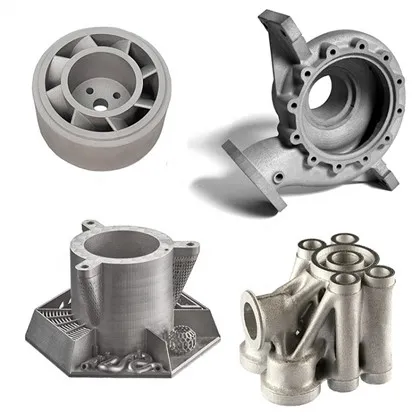
Suspension upright consolidation: Carbon Performance combined nine separate components of a Lotus sports car's suspension upright into a single 3D printed aluminum part, reducing weight and improving stiffness.
Brake caliper innovation: Bugatti's 3D printed titanium brake caliper passed pressure testing, demonstrating strength and durability superior to traditionally manufactured calipers.
Integrated cooling channels: BMW prints coolant channels directly into M-series cylinder heads, optimizing thermal management to boost engine performance.
Full vehicle structure printing: Local Motors 3D printed the body of its Strati electric vehicle, and Honda printed side panels for its Micro Commuter concept - both demonstrating the potential of 3D printing at the whole-vehicle structural level.
The Significance of Part Consolidation

Carbon Performance's consolidation of nine separate components of a Lotus sports car's suspension upright into a single 3D printed aluminum part is a particularly telling example, because it reveals one of the fundamental advantages that sets 3D printing apart from traditional manufacturing: part consolidation. Traditional manufacturing, constrained by how parts are machined and assembled, often requires breaking a complex functional component into several simpler pieces that are machined separately and then joined together with bolts or welds. Every one of those joints is a potential weak point and a potential failure risk, and each also adds assembly time and quality-control complexity.
The additive-manufacturing logic behind 3D printing breaks that constraint entirely. Designers can start directly from the functional requirement and design a single, integrated complex structure - folding the function of nine separate parts into one printed component. This not only reduces part count and assembly complexity, but also - by eliminating multiple joints - significantly improves overall structural stiffness and reliability, while also achieving weight savings.
Bugatti's 3D printed titanium brake caliper similarly illustrates 3D printing's potential in extreme-performance components. Brake calipers have to withstand enormous braking pressure and repeated thermal cycling. Bugatti's titanium caliper, produced via 3D printing, went through rigorous pressure testing and demonstrated strength and durability that outperformed calipers made through traditional forging or casting - proof that additive manufacturing can now compete head-to-head with traditional processes on high-performance, safety-critical components.
Early Exploration of Full-Vehicle Structure Printing
Local Motors' 3D printed Strati electric vehicle and Honda's 3D printed side panels for the Micro Commuter concept represent early exploration of 3D printing extending from the component level up to whole-vehicle structural applications. While these projects currently remain largely at the concept-validation and small-batch-production stage, they demonstrate the feasibility of 3D printing for large body-level structural components, building valuable technical experience and data toward larger-scale full-vehicle 3D printing down the road.
Advancing Standardization and Certification: The Critical Step from Lab to Production Line
Advancing standardization and certification: The SYMPA project is developing automotive-certified SLA resins. The IDAM project, coordinated by BMW, focuses on industrializing additive manufacturing processes and automation systems. The NextGenAM project partners with the aerospace sector to optimize production efficiency.
Lowering the barrier for manufacturers: Once printing processes and materials are certified, small and mid-sized companies can adopt compliant hardware directly to produce parts, without bearing the high cost of independent certification - accelerating the adoption of 3D printing across the automotive industry.
Standardization and certification work is often the most easily overlooked, yet most critical, part of moving a new technology from the lab into large-scale industrial application. The automotive industry holds extremely strict regulatory requirements around material performance and safety standards for components - even a new material or process that performs impressively on a technical level will struggle to be widely adopted in production vehicles without industry certification.
The SYMPA project focuses on developing automotive-certified SLA photosensitive resin materials, clearing a compliance path for resin-based 3D printing materials to enter the automotive parts supply chain. The IDAM project, coordinated by BMW, focuses on the industrial integration of the entire additive manufacturing workflow with automation systems, exploring how to transform a 3D printing process that currently relies heavily on manual intervention into one that can run stably and at scale in an automated production line. The NextGenAM project goes a step further, partnering with the aerospace industry to jointly optimize metal additive manufacturing efficiency - since aerospace has accumulated more mature experience in quality control and certification for metal 3D printing, and this kind of cross-industry collaboration helps accelerate the automotive sector's technology maturation.
Once these certification frameworks are established and rolled out, they'll significantly lower the barrier for small and mid-sized manufacturers to adopt 3D printing. Today, completing material and process certification independently requires a substantial investment of time and money - often more than a smaller company can bear. Once industry standards and certification processes are in place, smaller companies can adopt already-certified, compliant hardware and material systems directly for production, without duplicating that certification investment. This will dramatically speed up the spread of 3D printing across the entire automotive supply chain, especially letting second- and third-tier parts suppliers also benefit from the efficiency gains the technology offers.
The Future of 3D Printed Cars
The feasibility of a fully 3D printed vehicle: As 3D printing technology matures for core components like batteries, motors, and sensors, future vehicles may eventually be printed in full, from engine to wheels. Printable magnets already exist, for example - 3D printing an electric motor mainly needs to overcome challenges in automated assembly and material compatibility.
Automated assembly challenges: Current obstacles include robotic systems' ability to integrate parts coming from multiple printers. Projects like IDAM are building advanced manufacturing facilities to help push this goal forward.
Expected industry transformation: While flying cars remain a distant prospect, 3D printed cars could move from concept to production within the next decade, fundamentally reshaping the supply chains and production models of traditional automotive manufacturing.
The Technical Puzzle Pieces Toward a Fully Printed Vehicle
Truly achieving a "fully 3D printed vehicle" requires solving more than just body structural printing - the more central challenge lies in the additive manufacturing of highly integrated core components like batteries, motors, and sensors. Printable magnetic materials have already achieved a breakthrough, meaning the permanent magnets at the heart of an electric motor can now be produced via printing, laying a material foundation for further integrating motor production into the printing process. Fully 3D printing an entire motor, however, still requires solving the challenge of jointly printing multiple different materials and functional modules - coil windings, insulation materials, cooling structures, and more - which remains a key focus of current technical research.
Automated Assembly Is the Last Mile to Scale
Even once every individual component can be produced via 3D printing, the capability of the automated assembly stage is equally critical to achieving vehicle-scale production. The current industry bottleneck is that robotic systems, when integrating parts coming from different printers and different production batches, often need custom-programmed gripping and assembly paths for each part type - lacking the flexibility and versatility needed to handle the high-mix, low-volume nature of 3D printed parts production. Industry collaborations like the IDAM project are working to build more advanced automated manufacturing facilities, exploring how to make robotic systems more intelligently adaptive to the variety of 3D printed parts - a critical threshold that must be crossed to achieve scaled production of fully 3D printed vehicles.
A Ten-Year Window for Transformation
While producing a fully 3D printed, road-ready flying car remains a distant prospect for now, the current trajectory of technology development suggests that 3D printed cars could gradually move from concept validation toward small-scale production within the next decade. This shift will involve more than just an upgrade at the manufacturing-process level - it stands to fundamentally reshape the supply chain structure and production organization of the traditional automotive industry, moving away from a model built on large-scale standardized production and centralized tooling investment, toward a more flexible, distributed, on-demand model of digital manufacturing.
Conclusion
By shortening development cycles, lowering production costs, and enabling complex designs, 3D printing has become a core driver of innovation in automotive manufacturing. As breakthroughs continue in materials science and automation, the era of the fully 3D printed vehicle is approaching - bringing the industry unprecedented efficiency and customization potential. From rapid iteration during prototype validation, to lightweight upgrades in production tooling, to customized and on-demand end-use part manufacturing, all the way to the future vision of a fully printed vehicle, 3D printing is systematically reshaping every stage of automotive manufacturing, pushing the entire industry toward greater efficiency, flexibility, and personalization.