
Quarterly 3D printer revenues rose and shipments slowed as global markets reacted to inflation, with higher prices, divestments, and currency fluctuations complicating growth expectations for additive manufacturing.
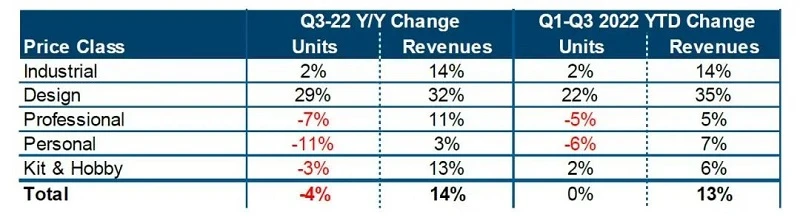
On January 10, 2023, 3D printing research organization CONTEXT recently released data showing that in the third quarter of 2022, the total global 3D printer shipments fell by 4%, while the system (equipment) sales revenue increased during this period. 14%.
“While shipments of 3D printers vary widely across price classes, systems revenues are all up from a year ago,” said Chris Connery, global head of analytics at CONTEXT.
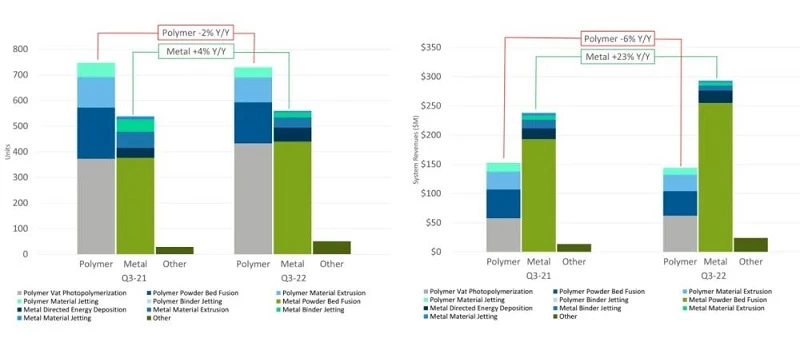
The report shows that shipments of industrial-grade 3D printers grew by only 2%, with metal 3D printers up 4% and industrial polymer 3D printers down 2%. Shipments of Professional, Personal, and Kit & Hobby grades declined -7%, -11%, and -3% year-over-year due to the combined impact of demand and supply chain. Therefore, growth in the 3D printing industry this quarter has more to do with revenue than shipment growth.
Inflationary pressures around the world led to higher equipment prices across all classes, underpinning revenue growth. Industrial-grade metal producers also benefited again from a shift in demand for more efficient and productive machinery, driving higher industry revenues. Such as metal powder bed fusion equipment has more lasers and higher efficiency, which can achieve higher output.
Industrial equipment
Not only is China the largest market globally (35% of the world's industrial 3D printers are shipped there), but it is also seeing higher growth (+34%), higher than either North America or Western Europe.
Chris Connery pointed out: "Many high-profile 3D printer companies have made layoffs because the industry dynamics are different from what they were at the beginning of the year. Some companies are facing supply chain challenges that hinder their ability to ship more equipment, while others are affected. The impact of stagnant demand."
Amid fears of an impending recession, some end markets are reducing capital spending as a precautionary measure until global macroeconomic conditions stabilize.
Industrial-grade market leader EOS Germany, which has the highest system (equipment) revenue in its class, is growing far faster than shipments, with system revenue up 35% year-over-year, while shipments grew just 1%.
Design Grade Equipment
Shipments of design-grade 3D printer systems rose significantly to +29% in Q3 2022, bringing full-year growth to +22%. This was largely due to sales of new products in the category, including the Formlabs Fuse 1+30W (already the fourth best-selling product in this price category), Stratasys' Origin P3, photocentric's LC Magna, and Desktop Metal's carbon fiber systems. New models accounted for 15% of the category's shipments, and the two products, Fuse 1+30W and Origin P3 accounted for 9% of the category's total.
Professional Grade Equipment
In the professional price category, shipments were down -7% compared to Q3 2021. FDM/FFF printer shipments were down -8%, and SLA printer shipments were down 21% from a year ago. FDM shipments have been relatively flat through the third quarter, down only -1% from product shipments in the same period in 2021, but the same is not true for SLA shipments, down -19% from 2021. Ultimaker (the newly merged MakerBot and Ultimaker), which makes both professional and personal printers, has a market share of 36% in this price class, but overall, shipments in this price class are down -14%. In Q3 2022, UltiMaker and Formlabs (whose unit shipments also declined) combined accounted for 51% of global professional systems revenue in Q3 2022. A newcomer to the category this quarter is Nexa3D, with shipments of its XiP printers on the rise.
Outlook
Forecasts for 2023 have turned cautious amid fears of a regional recession and concerns that an easing of China's zero-tariff policy could reduce domestic demand and lead to further supply chain disruptions.
However, forecasts for key end markets (including aerospace) and key modes—particularly metal powder bed fusion—remain strong. BLT and Yijia 3D together with SLM Solutions and Velo3D have released new large-scale multi-laser system metal systems to meet this growing demand. Now that HP has fully rolled out its metal jetting equipment, and GE Additive hopes to commercialize its line of products, metal binder jetting equipment may also make 3D printing a mainstream manufacturing process in the coming year.
Chris Connery added: "As seen in 2022, system (device) revenue growth is expected to be much higher than device shipment growth, with all technology revenue now forecast to grow +19% this year, while device Volume growth is expected to be only +9%.”