
From traditional subtractive manufacturing to emerging additive manufacturing, different metal fabrication and processing methods have a significant impact on the material structure and mechanical properties of the final product. The influence of traditional manufacturing methods on the mechanical properties of metals has been widely recognized, but the relationship between additive manufacturing processes and product characteristics is quite complex and is an important topic in the research field.
Among the many studies, the impact of 3D printing process interruption on the microstructure and properties of metal additively manufactured parts is a niche topic. Additive manufacturing processes rely on continuously printing material layer by layer, with stringent melting and solidification requirements. When the printing process is interrupted, the thermodynamics that controls bond strength and defect generation within the layer is disturbed. Interruptions in additive manufacturing processes are expected to affect interlayer bonding, compromising the development of uniform microstructure and mechanical properties of metal parts.
Even without considering process interruptions, there is clear room for improvement in metal additive manufacturing in terms of dimensional accuracy and material properties. During 3D printing, solidification kinetics and interlayer bonding determine the grain structure and mechanical properties of the part, which are governed by thermal gradients, cooling rates, and thermal cycling. While the fusion process for 3D printing is difficult to control, these factors can be optimized through continuous and uninterrupted deposition and thermal control.
However, during 3D printing production, process interruptions may occur due to the possible need to embed monitoring elements (such as sensors, actuators, and energy harvesting devices), replenish materials, change production schedules, etc. In addition, process interruptions can also occur due to power outages and machine failures. When the printing process is interrupted, the printed part will gradually cool, resulting in the appearance of defects and inhomogeneous microstructures due to interruptions in thermal cycling and irregular thermal gradients. Consequently, the mechanical properties of the final product are compromised. Possible defects include lack of fusion, keyhole collapse, porosity, solidification cracking, solid-state cracking, poor interlaminar/surface bond strength, incomplete binder debinding, etc.
The impact of process interruptions on the overall performance of 3D printing parts
For most metal 3D printing processes, process interruptions show up with visible color at the joints, which are called "process marks". In the interrupted areas of the studied samples, both color changes due to thermal effects and defects in the part are present. Visible defects may persist along process interruption lines and are expected to negatively impact the mechanical properties of the samples. To further examine the samples and sliced samples, NDT experiments were performed to further evaluate potential changes in material structure and mechanical properties before and after process interruption.
Researchers from the University of Jordan have investigated process interruptions during arc wire additive manufacturing. They took 130×17×150mm parts as the research object and used Ti-6Al-4V for printing. After 8 hours and the molding, height reached 120mm, the printing was interrupted, and the printing process was resumed after the dead time lasted for 6 hours. During this time, the molded part cools to room temperature.

Samples printed by researchers can be cut out for analysis
Variations in the thermal history of the part may have affected the formation of the grain structure. The main difference between the microstructure in normal and interrupted manufacturing process regions is the size of the grains. While the grain size of the samples is fairly uniform under normal process conditions, the samples from the region where the process was interrupted had non-uniform grain sizes. Texture and grain size differences in the normal process and interrupted process regions were the main findings of the microscopic evaluation. In addition, due to the interaction of the conditions of the previously deposited layers and the interaction of the new deposition process, the solidification conditions (such as weld pool shape and growth rate), thermal gradients, and cooling rates may have changed, and the mechanism of defect generation will also be affected.

Visible defects at process interruption lines
Testing by resonant ultrasonic spectroscopy revealed important changes in part integrity; testing of nanomechanical properties found a reduction in Young's modulus and hardness values in areas where the process was interrupted; X-ray computed tomography revealed the number of defects contained in the interrupted areas more and larger in size than the other regions; significant signal attenuation and backscatter are shown in the ultrasound signal.
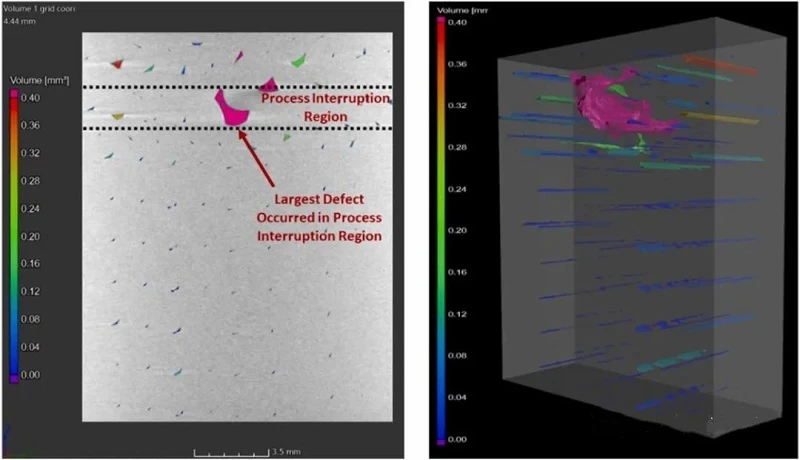
CT image of the area where the process was interrupted
Testing of material properties concluded that the process interruption had a significant impact on the primary material and mechanical properties of the part. The grain structure, texture, and defect levels of samples fabricated at or after the interrupted area did appear to be different from samples that did not experience any process interruption or were previously printed. In particular, the strength and integrity of the part are lower in the interrupted region; and the size and distribution of defects in the interrupted region are much higher.
Process interruptions inspire 3D printing remanufacturing and repair
Since the size and distribution of defects such as cracks and porosity have been shown to significantly alter the structural integrity and material properties of additively manufactured parts, the area of disruption can be a critical area that affects the safety of the overall structure. This is especially important when considering some kind of process disruption, especially a remanufacturing process or repair using additive manufacturing.
For this reason, when these components are used as critical components in aerospace, medical and transportation applications, the quality assurance process of these components may be subject to more stringent quality testing and non-destructive testing. Severity and defect distribution in process interruption regions can be reduced by some pre- and post-fab processes. Preheating the part to manufacturing temperature before restarting the process after an interruption reduces the effects of thermal shock and stress, and reduces the development of defects and cracks. In terms of post-processing, several remedies such as heat treatment processes or hot isostatic pressing (HIP) may help improve part integrity and performance. These proposed considerations must be investigated in future studies to determine the exact suitability and impact on the quality of the final assembly.