
What if doctors could print a kidney from a patient's cells without having to find a matching donor organ and worry about being rejected by the patient's body?
With the help of 3D bioprinting, this could be realized as soon as a decade, says Professor Jennifer Lewis of Harvard's Weiss Institute for Bioengineering. Organ bioprinting is the use of 3D printing technology to assemble multiple cell types, growth factors, and biomaterials in a layer-by-layer fashion to create artificial organs that perfectly mimic natural organs, according to the study. This regenerative medicine is in the research and development stage, and the driving force behind it is "the real human need".
Desperate waiting
About 1 million people worldwide need kidneys. They reach end-stage renal failure and must undergo dialysis. Dialysis imposes a heavy burden on the body, and with each passing year, the risk of death of patients increases significantly. So the drive to tackle the grand challenge of organ 3D printing is really big.
Magic ink
To start the process of bioprinting organs, doctors usually start with the patient's own cells. They perform a small needle biopsy of an organ, or perform minimally invasive surgery, to remove a small piece of tissue "less than half the size of a postage stamp." Using this tissue removed, the cells can be disassembled and cultured in vitro.
Cultivation takes place in sterile incubators or bioreactors, pressurized stainless steel vessels that help cells get enough nutrients. Doctors feed them nutrients (medium) every 24 hours because cells have their own metabolism. Different cell types require different nutrients. Then we mix it with the gel, which is like glue. Every organ in your body is made of cells and the glue that holds them together.
Glue is the nickname for bio-ink, a printable mixture of living cells, water-rich molecules called hydrogels, culture medium, and growth factors that help cells continue to proliferate and differentiate. The hydrogel mimics the body's extracellular matrix—it contains substances such as proteins, collagen, and hyaluronic acid.
Commonly used biomaterials must be non-toxic, biodegradable, and biocompatible to avoid adverse immune responses. Collagen and gelatin are the two most commonly used biomaterials when bioprinting tissues or organs.
Witness the moment of miracle
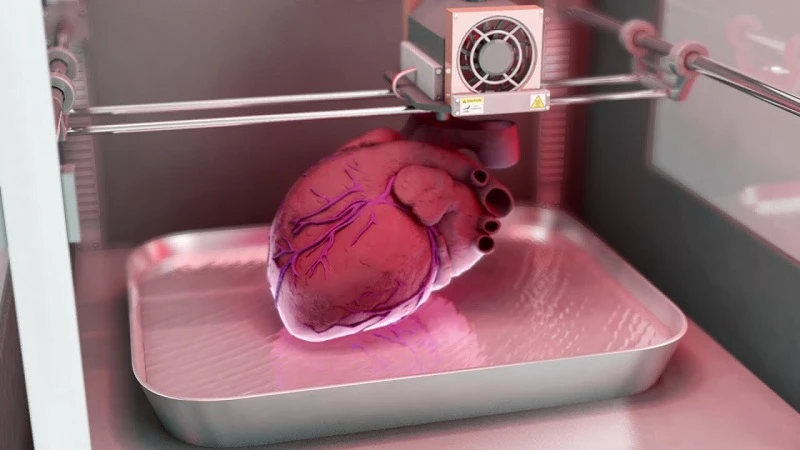
Doctors put each bio-ink -- the type of ink depending on how many cell types they want to print -- into a print cartridge, "extruding the bio-ink through a printhead and nozzle, building up the material layer by layer."

After the bioprinted organ is implanted in the patient, it will naturally degrade over time, the glue will dissolve, and the cell will feel that the 'bridge' is collapsing; the cell will feel that its foundation is no longer solid. So the cells will make their own bridges and make their own glues in your body.