

Hey there! As a supplier of Conformal Cooling Inserts, I've been getting a lot of questions lately about how these nifty inserts affect the cooling of thin - walled parts. So, I thought I'd sit down and share my insights on this topic.
First off, let's talk about what thin - walled parts are. These are parts with a relatively small wall thickness compared to their overall size. They're used in a whole bunch of industries, from automotive to consumer electronics. The problem with cooling thin - walled parts is that they have a high surface - to - volume ratio. This means that heat can build up quickly, and traditional cooling methods might not be enough to get the job done efficiently.
That's where Conformal Cooling Inserts come in. These inserts are designed to follow the shape of the part being cooled, hence the name "conformal." They can be placed very close to the surface of the thin - walled part, which allows for much more effective heat transfer.
One of the key benefits of using Conformal Cooling Inserts for thin - walled parts is the reduction in cooling time. In traditional cooling systems, the cooling channels are often straight and far from the part's surface. This leads to a slower transfer of heat, which in turn increases the time it takes for the part to cool down. With conformal cooling, the inserts can be customized to fit the exact shape of the thin - walled part, bringing the cooling channels closer to the heat source. This results in a faster cooling rate, which can significantly reduce the cycle time in manufacturing processes like injection molding.
For example, in the production of 3D Printed Special - Shaped Diesel Engine Swirl Chamber, thin - walled components need to be cooled quickly to maintain their shape and mechanical properties. Conformal Cooling Inserts can help achieve this by providing a more uniform and rapid cooling effect.
Another advantage is the improvement in part quality. When thin - walled parts cool unevenly, it can lead to issues like warping, shrinkage, and residual stresses. These problems can compromise the functionality and aesthetics of the final product. Conformal Cooling Inserts ensure a more consistent cooling rate across the entire part, reducing the likelihood of these defects. This means that the parts produced are more dimensionally accurate and have better mechanical properties.
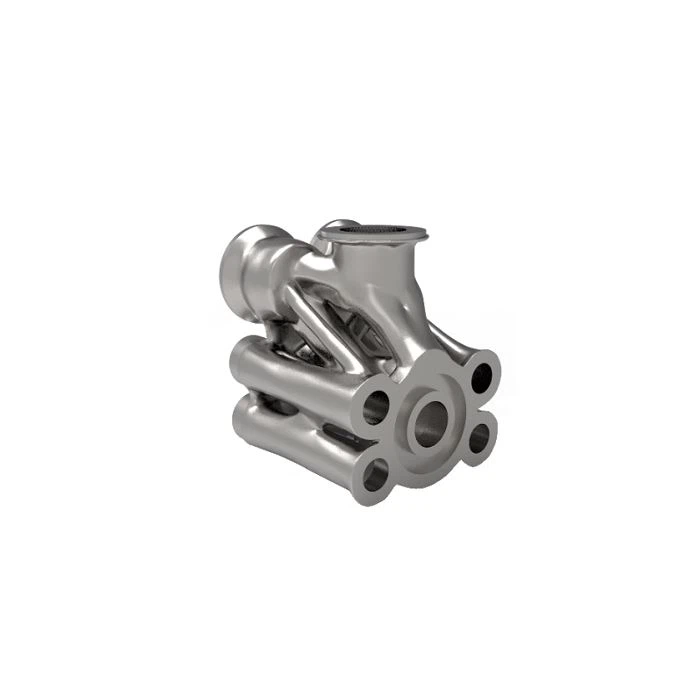
Take the Stainless Steel 316L 3D Printing Hydraulic Manifold as an example. The thin - walled sections of this manifold need to be cooled precisely to maintain the integrity of the fluid channels and the overall structure. Conformal Cooling Inserts can help achieve this by providing targeted cooling where it's needed most.
Now, let's discuss how Conformal Cooling Inserts are made. Thanks to advancements in 3D printing technology, we can create these inserts with complex geometries that were previously impossible to manufacture. 3D printing allows us to build the inserts layer by layer, incorporating the exact shape and configuration of the cooling channels required for the thin - walled part. This level of customization is a game - changer in the field of cooling technology.

The materials used for Conformal Cooling Inserts also play a crucial role in their performance. We often use materials with high thermal conductivity, such as copper alloys or certain types of stainless steel. These materials can transfer heat more effectively, enhancing the cooling efficiency of the inserts.
In the aerospace industry, for instance, Topology Optimization For Aircraft Brackets involves the use of thin - walled parts. These parts need to be cooled quickly and uniformly to ensure their structural integrity. Conformal Cooling Inserts made from suitable materials can help meet these requirements, contributing to the overall safety and performance of the aircraft.
However, it's not all sunshine and rainbows. There are some challenges associated with using Conformal Cooling Inserts for thin - walled parts. One of the main issues is the cost. 3D printing the inserts can be expensive, especially for small - scale production runs. Additionally, the design process requires a high level of expertise to ensure that the inserts are optimized for the specific part.
Another challenge is the maintenance of the inserts. Since they have complex geometries, they can be more difficult to clean and inspect compared to traditional cooling channels. This means that proper maintenance procedures need to be established to ensure the long - term performance of the inserts.
Despite these challenges, the benefits of using Conformal Cooling Inserts for thin - walled parts far outweigh the drawbacks. The potential for reducing cycle times, improving part quality, and enhancing overall manufacturing efficiency makes them a valuable investment for many industries.
If you're in the market for Conformal Cooling Inserts for your thin - walled parts, I'd love to have a chat with you. We can discuss your specific requirements, design a customized solution, and help you take your manufacturing processes to the next level. Whether you're in the automotive, aerospace, or consumer electronics industry, we've got the expertise and the technology to provide you with high - quality Conformal Cooling Inserts.
So, don't hesitate to reach out and start the conversation. Let's work together to find the best cooling solution for your thin - walled parts.
References:
- Industry reports on cooling technology in manufacturing
- Research papers on 3D printing and its applications in cooling systems
- Case studies on the use of Conformal Cooling Inserts in various industries