
3D printing has many advantages, the ability to produce complex structural parts with unconventional concepts is its biggest feature, which can greatly reduce the application of materials and reduce the weight of parts while ensuring their strength. The structural design of parts plays a pivotal role in giving full play to the advantages of 3D printing, which requires us to break the traditional design concept and give full play to our imagination and creativity.
Several 3D printing part design ideas are recommended.
1. For the purpose of lightweight
Lightweight design requirements require topological optimization of parts in the structure. The advantage of topology optimization is that it can still meet the lightweight design requirements of parts while reducing the amount of material. 3D printing is the most convenient preparation method for topology optimization of complex structural designs. This is of great significance in the aerospace field and can significantly reduce the weight of the aircraft. Taking the speed brake bracket as an example, the weight of the titanium alloy bracket manufactured by traditional technology is 430.3g, and the weight is reduced by 22% after the structural optimization design.

At present, the lightweight structures commonly used are as follows:
●Truss/rigid frame structure
The rigid frame structure is composed of some thin rods connected by some nodes. It can meet the required physical strength, force stability, and self-balancing requirements while saving materials and realizing printing requirements.

The truss structure is made of Al alloy through 3D printing. The overall weight is 35% lighter than that of traditional manufacturing, and the rigidity is increased by 40%. In addition, there is a skin-rigid structure derived from the truss structure, that is, the outer surface is a thin-walled structure and the interior is a hinged member. This structure can be embodied in the form of thin-walled and hinged support rods in 3D printing technology.
●Lattice sandwich structure
The characteristic of the lattice sandwich structure in the process of weight reduction is to optimize the structure and at the same time ensure sufficient strength of the material. In the aerospace industry, the lattice sandwich structure is often used to make various wall panels.

The material of the aero-engine lubricating system is a Ti-6Al-4V oil and gas separator. Its working principle is to separate the gas in the oil return. The porosity of this grid structure is as high as 95%, and the density is reduced to 0.5g/cm2 so that when the oil and gas mixture passes through, the small oil droplets are adsorbed in the separator. Rolls-Royce used this structure to achieve oil and gas separation efficiencies as high as 99%.
The problem with this structure is that the unmelted metal powder adheres to the frame and is difficult to remove during the manufacturing process.
●Hollow structure
The hollow structure is that the shell is hollow inside the thin wall or a simple strut structure is added inside. The disadvantage of this structure is that it requires internal support, and the support is difficult or impossible to remove.
2. For the purpose of biocompatibility
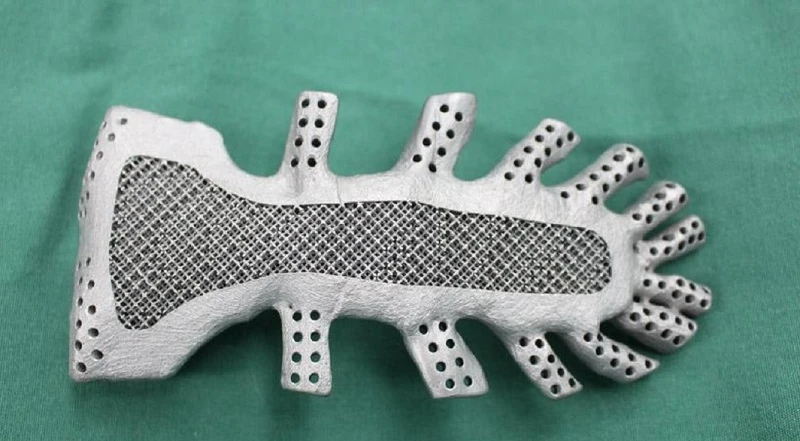
Porous and cellular structures in medical implants require through-hole structures that facilitate bone growth and cell migration. At the same time, in order to avoid the "stress shielding" phenomenon caused by the high elastic modulus of the metal, the mechanical properties of the implant are guaranteed to match the real bone structure. It is necessary to design and manufacture the unique porous structure/cell structure of 3D printing, and complete the printing process after designing the type, pore size, pore wall thickness, and porosity according to the needs.
●Porous structure/cell structure
The paper "Application of Powder Bed Fusion Technology in Medical Implant Fabrication" introduces four kinds of porous structure/cell structure units, which are similar in structure to lattice sandwich structure to achieve lightweight requirements. But the purpose is different, the purpose is to ensure that the biological implant composed of structural units has good biocompatibility. It has been proved by biological experiments that this structural implant has good biocompatibility, and a large amount of bone tissue grows into the pore structure.
3. Other complex structures
●Space special-shaped pipeline structure
The traditional manufacturing process of space special-shaped pipelines is injection molding, casting, etc. In addition to the high manufacturing cost and long production cycle, the traditional process is difficult to successfully prepare the complex spline curve required for the pipeline. Conformal cooling technology combines mold making with 3D printing to solve the way the complex shapes of space pipes are formed.
●Integrated complex structure
The integrated complex structure is further divided into the static mechanism and dynamic mechanism. Among them, the most famous static mechanism design is GE's fuel injector. The characteristics of the dynamic integration mechanism are that it is free of assembly and can realize the dynamic connection. Traditional mechanical components need to print each single piece step by step and then assemble the single piece. 3D printing can save assembly steps and directly obtain an assembly-free overall mechanism. Typical representative - universal joint.
●Space free-form surface structure
Freeform structures are difficult or impossible to machine using traditional methods.
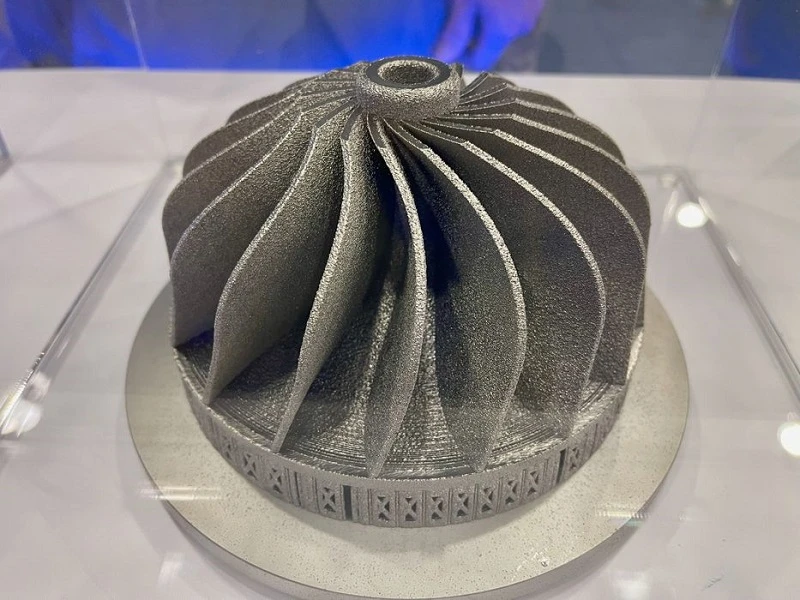
For example, engine blades are typical representatives of such thin-walled and complex free-form surfaces. Blades prepared by traditional casting methods and CNC machining techniques have the disadvantages of poor surface quality and low processing efficiency, respectively. Additive manufacturing technology provides technical conditions for the manufacture of blades with high geometric accuracy and good surface quality. In addition, the lattice sandwich structure can be combined with the free-form surface structure to achieve the purpose of lightweight complex surfaces.